CiteTrue
CiteTrue validates reference lists field by field against Crossref, PubMed, IEEE, arXiv and other academic indexes, flagging fabricated or AI-generated citations with per-reference confidence scores.
About CiteTrue
Introduction
Citation fabrication is no longer an anecdotal risk. Peer-reviewed findings cited on the platform report that 55% of the bibliographic citations generated by GPT-3.5 — and 18% of those produced by GPT-4 — were fabricated outright, while retractions passed 10,000 papers in a single year. CiteTrue positions itself as a free citation checker that closes that gap: a reference list goes in, an authenticity report comes out. The tool cross-references each entry against major academic databases and flags references that are fake, misattributed, or subtly mangled.
Key Features
Multi-database cross-referencing. Rather than trusting a single index, CiteTrue queries a broad set of sources in parallel. The interface displays arXiv, CORE, Crossref, Google Scholar, OpenAlex, ResearchGate, ACM, BMC, Cambridge University Press, Elsevier, IEEE, OpenLibrary, PubMed, ScienceDirect, Semantic Scholar, Springer, and Wiley, alongside additional paid data sources. Matching a reference across several independent indexes dramatically reduces the chance of a false positive.
Field-by-field validation. The core design decision is that a citation can point at a real paper and still be wrong. Each reference is decomposed into discrete fields, and each field is checked separately against the matched record:
- Title — matched against the indexed record, catching references to papers that were never published.
- Authors — compared name by name, exposing real papers credited to the wrong researchers.
- Year — reconciled with the publication date on record, catching year drift introduced by copy-paste or an AI guess.
- DOI / identifier — resolved against the registry that issued it, surfacing dead links and invented DOIs.
- Venue, volume, pages — compared field by field to catch numeric details silently altered in transit.
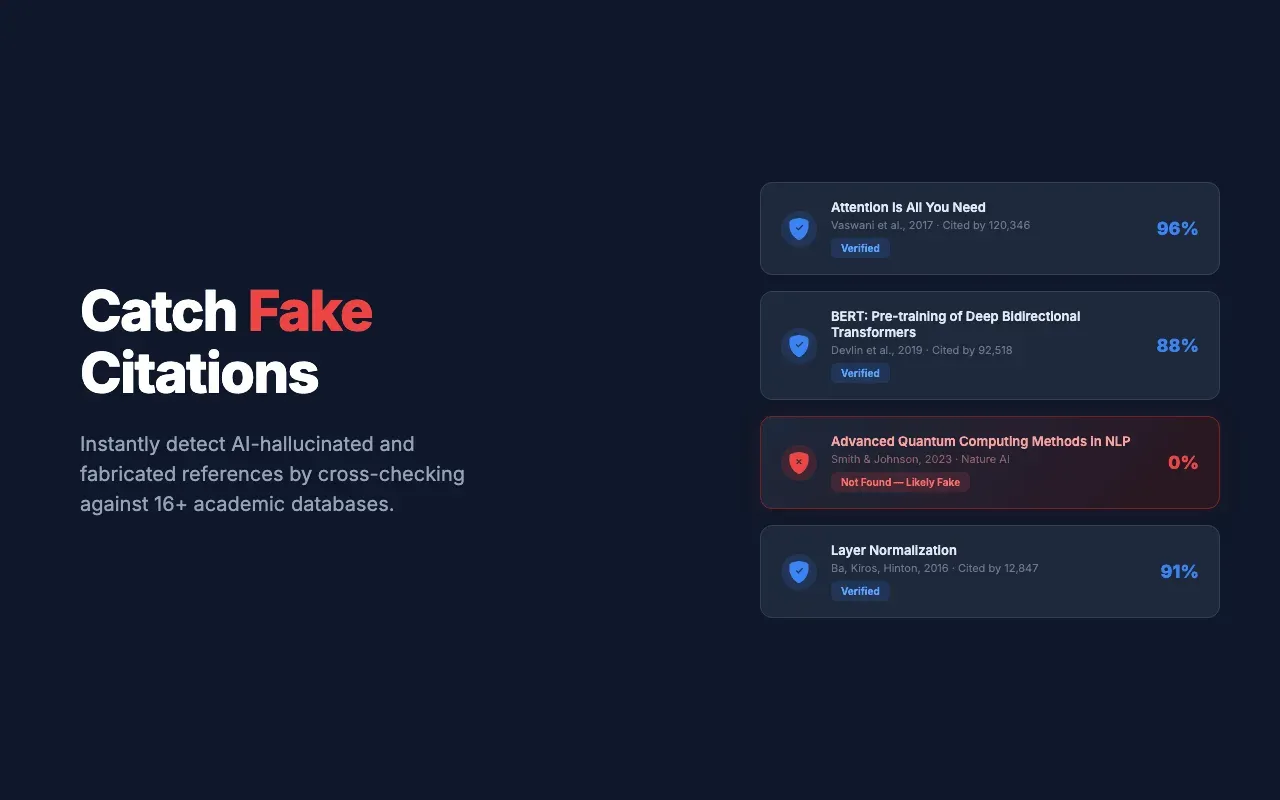
Confidence scoring. A proprietary scoring model evaluates overall citation accuracy and returns a confidence score indicating how likely an entry is to be authentic. Low-scoring entries are flagged as Not Found or marked with a specific mismatch such as a year discrepancy, which turns a binary pass/fail into a graded diagnostic.
Format handling. Input does not need to be perfectly formatted. The checker accepts references in APA, MLA, and other common styles, and normalizes the input before verification, so a messy bibliography does not require manual cleanup first.
Batch throughput. Dozens or hundreds of references can be submitted in a single pass, which is the practical difference between spot-checking a paper and validating an entire dissertation bibliography.
Ecosystem tools. CiteTrue ships as a suite rather than a single utility: a citation finder that returns real peer-reviewed sources for a paragraph, a paper draft generator that ties each sentence to a source, and an AI humanizer for rewriting AI-generated prose. A Chrome extension and a native Mac app extend the checker beyond the browser tab, while an API and an MCP server let the verification pipeline be invoked programmatically.
Multilingual interface. The product is localized into English, French, German, Italian, Spanish, Portuguese, Russian, Arabic, Chinese, Japanese, and Korean.
How It Works
The pipeline is explicit and visible in the interface. Text enters the system, is split into individual citations, and enters a task queue. From there, parallel queries fan out to databases A, B, C and onward; results are analyzed, additional databases are queried as needed, and the aggregate analysis is compiled into a report.
Two input modes exist. Reference-list mode expects a standard numbered or bulleted bibliography and is the default path. Search mode handles general text and in-text citations — if the parser detects in-text citations such as (Smith, 2020) inside prose, it warns the user and switches modes automatically, since a narrative sentence is not a valid reference list.
The warning layer is a notable engineering detail. If no citations are detected, the system says so rather than returning an empty report. If the text structure is too complex for Fast Verify to parse reliably, it refuses to guess and instead recommends either Deep Verify — a heavier, more expensive pass — or reformatting the input as a standard reference list.
Fast Verify and Deep Verify differ mainly in cost and effort: Deep Verify consumes roughly five times the credits per reference, reflecting additional retrieval and matching work. For clean, well-structured bibliographies Fast Verify is normally sufficient; for garbled or highly heterogeneous lists, Deep Verify is the safer route.
Output arrives as a verification report with per-reference statuses and confidence scores. Detection cases shown in the product demo include a fully verified reference, a partial match with a year mismatch scored at 70%, and a fabricated entry scored at 0%. A history panel retains past runs, and an authenticated dashboard keeps results accessible across sessions. The Chrome extension and Mac app route the same pipeline through a native surface, while developers can wire the API or MCP server into editorial and research tooling, with setup documentation published separately.
Use Cases
Students and early-career researchers. Undergraduates and master's candidates writing course papers are the most exposed to citation errors inherited from web sources. Running a bibliography through the checker before submission eliminates a class of rejections that has nothing to do with the quality of the argument.
Doctoral candidates. A thesis can carry several hundred references. Manual verification is impractical, and AI-assisted drafting has made hallucinated entries more common. Batch verification converts an unbounded manual task into a single operation.
Advisors, professors, and supervisors. Faculty reviewing student work need to distinguish sloppy citation from deliberate fabrication. A confidence-scored report provides evidence rather than suspicion, which matters when academic misconduct proceedings are involved.
Journal editors and peer reviewers. Editorial screening is where fabrication does the most downstream damage. Filtering manuscripts with bogus references at the initial triage stage reduces reviewer workload and protects the journal's record, and editors handling high submission volumes gain the largest efficiency return.
Literature and systematic reviewers. Anyone reading papers to build on them depends on the accuracy of the references inside those papers. Verifying cited sources prevents a chain of reliance on sources that do not exist or say something other than what is claimed.
Developers and platform builders. The published API and MCP server make it possible to embed citation verification into reference managers, submission systems, plagiarism checkers, or institutional repositories.
Pricing & Value
CiteTrue's core positioning is free access: the product advertises a daily allowance of free citation checks and markets the checker itself as completely free. Beyond that allowance, the model is credit-based, and credits are consumed differently by mode — a fast check costs far less than a Deep Verify pass, which runs about five credits per reference. Credits can be replenished through referral rather than payment alone: inviting a colleague who signs up grants credits to both parties, and the credit dialog translates those credits into concrete work such as citation checks, alternative-source searches, or citation finder drafts. The pricing page carries current tiers and top-up options.
The value calculation is straightforward. A single fabricated reference in a submitted manuscript can trigger rejection, retraction, or a misconduct inquiry — outcomes with costs measured in months and reputation rather than dollars. Against that baseline, even a paid verification of a few hundred references is trivially cheap, and the free daily quota covers routine coursework and spot-checking without any spend at all.
Final Verdict
CiteTrue targets a real, measured problem with a defensible technical approach: parallel multi-database retrieval, per-field comparison, and a graded confidence score instead of a binary verdict. The field-by-field design is the strongest part of the argument, because most damaging citation errors are not invented papers but mangled metadata on real ones — wrong year, wrong author order, wrong volume. The evidence section is also unusually direct for a marketing page, leaning on cited peer-reviewed findings rather than assertion.
Limitations exist. Verification quality depends on the coverage of the underlying indexes, so recent, non-English, or grey-literature sources may not resolve cleanly and could be flagged unfairly. The credit model around Deep Verify adds a cost decision to every batch, and the most thorough verification work is deliberately gated behind that decision. The scoring model itself is proprietary and cannot be audited from the outside.
For anyone submitting academic work — students, doctoral candidates, faculty, or editors — citation verification deserves to be a standard pre-submission step, and the citation checker is a low-friction way to perform it, particularly with the free daily quota. For high-volume editorial pipelines and institutional workflows, the API and MCP integrations are the more interesting long-term play.
Pros
- Decomposes every reference into discrete fields — title, authors, year, DOI, venue, volume and pages — and validates each one separately instead of returning a single pass/fail verdict.
- Cross-references citations against an unusually broad index set spanning Crossref, PubMed, IEEE, arXiv, OpenAlex, Semantic Scholar, Springer, Wiley and Google Scholar in parallel.
- Handles entire bibliographies in one batch, so a dissertation with hundreds of references can be verified in a single operation rather than entry by entry.
- Substantiates its pitch with cited peer-reviewed evidence, including the 55% GPT-3.5 fabrication rate and the record 10,000+ retractions of 2023.
- Offers a free daily quota plus referral-funded credits, with API and MCP access for embedding verification into editorial or institutional workflows.
Cons
- Verification fidelity depends on the coverage of the underlying databases, so recent, non-English or grey-literature references may fail to resolve and be flagged as suspect.
- Deep Verify, the more thorough mode aimed at complex or badly formatted reference lists, consumes roughly five credits per reference and pushes heavy usage toward paid credits.
- The confidence score is produced by a proprietary model, so users cannot independently audit how any individual score was calculated.