StartupKit
StartupKit folds hiring pipelines, vulnerability disclosure, compliance training and cold outreach into one per-seat account, backed by 190+ annotated MCP tools that let AI assistants act on the same records.
About StartupKit
Introduction
StartupKit, frequently branded simply as Kit, merges four operational workstreams that early-stage companies normally purchase as separate subscriptions — recruiting, vulnerability disclosure, compliance training, and cold outreach — into one account. Pricing is per seat rather than per module: Hiring, the full Security workflow, Training, and Compensation Research (beta) ship together, while Outreach is the single separately billed add-on. The technical differentiator is a Model Context Protocol layer exposing more than 190 tools, allowing an AI assistant to operate on the same records a human recruiter sees in the browser.
Key Features
Hiring. Kit runs role-specific hiring pipelines with staged progression, GitHub code assignments, automated resume extraction, structured team reviews, and interview scheduling. Scheduling is bundled rather than sold as an add-on; candidates pick slots from the hiring team's real availability, and bookings attach directly to the candidate record. Candidates never create an account — a single private magic link opens their application, shows the current stage, and lets them respond to an offer. The platform ships 20 hiring process templates spanning 7 categories and 5 languages, each with predefined stages, candidate instructions, and timing, which can be copied and edited. A careers portal can be hosted on the customer's own domain.
Security. The vulnerability disclosure workflow covers report intake, triage, SLA countdowns (the interface surfaces items such as "17 hours to acknowledge"), duplicate detection, severity assignment, researcher appeals, bounty approval, and audit exports. Approving a bounty writes a ledger credit and notifies the researcher in the same operation. Researchers receive a portal on the customer's domain where they track fix verification and payout status, upload tax documents, or appeal a decision.
Training. Compliance courseware covers SOC 2, ISO 27001, GDPR, and HIPAA, and there are no per-learner fees. Trainees submit proof themselves — for example a screenshot of a locked screen together with its capture date and device name. Completion data accumulates in a register with one row per person including employee ID, department, role, and completion date, exportable as CSV or PDF, with individual evidence bundles available for auditors.
Outreach. Cold email is researched one prospect at a time using LinkedIn, company websites, and an internal knowledge base. Nothing is sent without explicit approval, and replies land in a single priority-ordered inbox tagged with detected sentiment. A silver-medalist lookup cross-references campaign prospects against hiring records to surface people who previously applied and were not hired.
MCP and AI. More than 190 tools expose hiring, security, training, and outreach operations to MCP clients. Tool annotations tell the client whether a call reads data, makes a destructive change, or contacts someone outside the company, so confirmation prompts appear before irreversible actions. A public MCP server works before signup, and access relies on scoped tokens that can be revoked.
Compensation Research. Currently in beta, this module collects advertised salary ranges from live job postings and refreshes them daily, with tracking by role and region and exportable comparisons. Coverage varies by role and market.
How It Works
Kit is built around three viewpoints that share one dataset: operator, external participant, and agent.
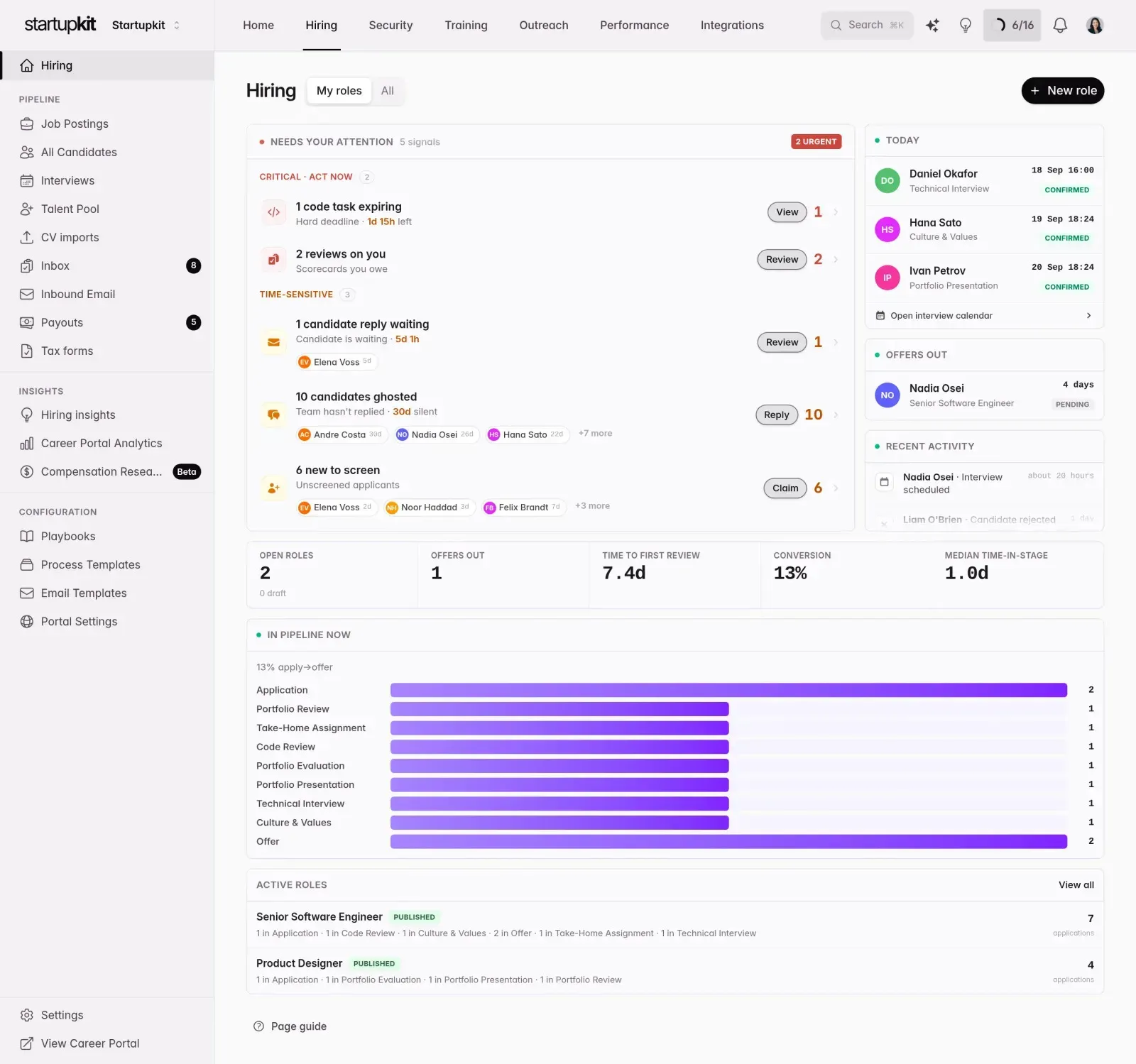
On the operator side, the dashboard is organized around a "needs your attention" column. Rather than a generic task list, it enumerates concrete blockers — five reviews waiting to be completed, a code task expiring in sixteen hours, twelve candidates still awaiting a reply, a security report with hours left on its acknowledgment SLA. This framing keeps the day's workload visible without configuration.
External participants never sign in. Candidates, security researchers, and trainees each receive a magic link that opens their own application, report, or course on the customer's domain. Whatever they submit — an offer acceptance, a payout preference, a screen-lock screenshot — flows back into the same record the internal team works from.
The agent layer is where Kit diverges from conventional HR and VDP tooling. A developer connects an assistant to Kit's MCP layer and issues natural-language instructions. Each tool call is annotated, so an action such as advancing an application to the offer stage carries a warning that it emails a real person, while a query such as listing training programmes is marked read-only. Onboarding is a single paste: the platform publishes a prompt at a documented endpoint that instructs the assistant to fetch and execute the correct setup steps. Integration coverage extends to Slack, GitHub, Google Calendar, Google Meet, webhooks, and any MCP-capable client.
Use Cases
Seed to Series A companies without dedicated operations staff. A ten-person team can run recruiting, answer security reports, deliver compliance training, and start outbound prospecting from one account and one invoice. Bundled scheduling and ready-made templates cut the configuration work that would otherwise span three or four separate products.
Security teams running a vulnerability disclosure programme. SLA tracking, duplicate detection, the bounty ledger, and the researcher communication thread address the parts of disclosure that are usually handled in spreadsheets and shared inboxes. Bounty approval records the ledger credit and notifies the researcher in one step, and audit exports support reporting obligations. The practical advantage over a standalone platform is that security reports sit beside hiring records rather than in an isolated silo.
Compliance and IT leads preparing for audits. An auditor requesting security-training evidence can be answered with a register export or a per-employee evidence bundle. Because trainees self-upload proof, the administrative burden of chasing certificates drops substantially.
Founders and recruiters running outbound. The research-then-approve model suits teams that want personalization without automated sending, and the silver-medalist lookup adds a sourcing channel that generic outreach tools lack.
AI-first engineering organisations. Teams already working inside Claude Code, Cursor, or GitHub Copilot can delegate routine record operations — reading applications, updating stages, drafting replies — without leaving their editor.
Pricing & Value
Kit is priced at €6.99 per seat per month, with equivalent tiers of $8, £5.99, and 29.99 zł depending on currency. The thirty-day trial requires a card at signup but is not charged; cancelling before day 30 avoids any cost. Seats can be added or removed at any time and the bill adjusts automatically.
Hiring, the complete Security workflow, and Training add no extra charge, and Compensation Research is included while in beta. Outreach is the sole paid add-on at €17.99 per month, bringing prospect research, the approval queue, reply detection, bounce handling, and its own MCP tools.
Training notably avoids per-learner pricing, which is where compliance platforms often become expensive as headcount grows. Customer data is stored on EU infrastructure, a data processing agreement is available to every customer, and account data can be exported before leaving. No separate startup discount exists; the published per-seat price applies uniformly. Further detail is available on the pricing page.
Final Verdict
Kit's case rests on consolidation economics and an unusually deep agent interface. A small company that would otherwise assemble an ATS, a disclosure platform, a training provider, and an outreach tool gets all four under one per-seat price, with portals external participants reach without creating accounts. The MCP implementation is the standout technical detail: 190-plus annotated tools, revocable scoped tokens, and a public server useful before signup represent a more considered integration than most vendors' "AI features" marketing.
The trade-offs are real but modest. Card-at-signup raises the barrier to casual evaluation. Outreach sits outside the headline price, so teams wanting all four products should budget roughly €24.98 per seat. Compensation Research remains in beta and its coverage is uneven across regions.
For engineering-led startups, security-conscious teams running a disclosure programme, and organisations preparing for SOC 2 or ISO 27001 audits, Kit merits a trial — particularly where the team already works inside an MCP-capable assistant. Teams with heavy enterprise recruiting requirements or existing enterprise contracts may find deeper specialist tooling elsewhere, but across the ten-to-fifty-person range the value proposition holds together.
Pros
- Four distinct workflows — hiring, vulnerability disclosure, compliance training, and outreach — share a single account, a single login, and a single per-seat invoice instead of requiring separate point tools.
- The MCP layer exposes over 190 annotated tools that explicitly flag read-only queries, destructive changes, and calls that contact people outside the company, with confirmation prompts firing before irreversible actions.
- Candidate, researcher, and trainee portals run on the customer's own domain and need no account creation, so external participants reach their next step through one private magic link.
- Training completion records export as CSV, PDF, or per-employee evidence bundles straight from a tamper-evident register, and the platform charges no per-learner fee.
- Customer data is hosted on EU infrastructure with a DPA available to every customer, and MCP connections use scoped, revocable access tokens.
Cons
- A credit card is required at signup even though the 30-day trial is never charged, which adds friction for teams doing quick evaluations.
- Outreach is billed separately at €17.99 per month, so the headline per-seat price does not reflect the cost of the complete feature set.
- Compensation Research is still labelled beta and its advertised-salary coverage varies noticeably by role and region.