Turbofy
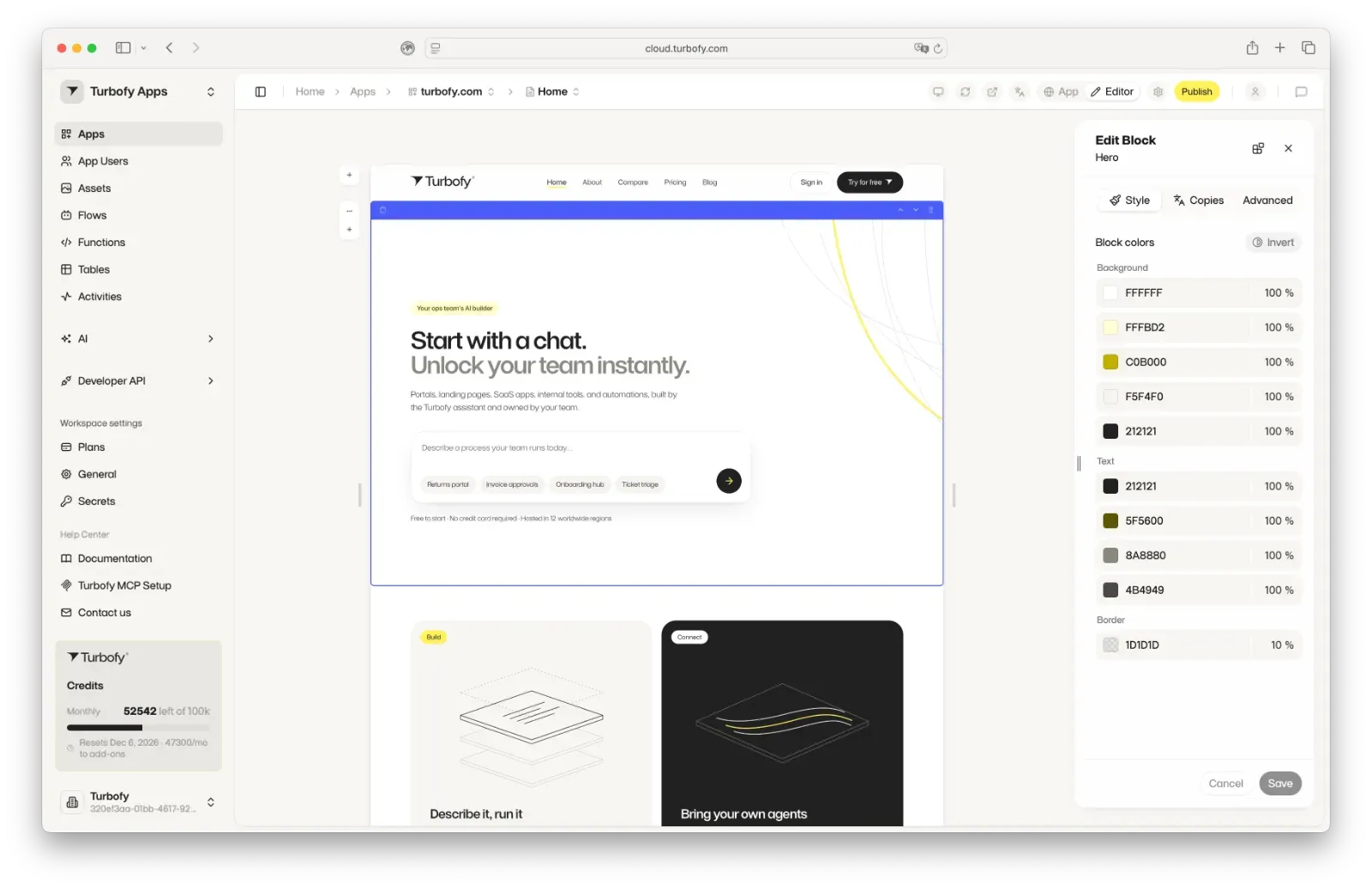
Turbofy turns plain-language process descriptions or MCP-connected coding agents into production business apps with data, authentication, hosting, and workflows included.
About Turbofy
Overview
Turbofy is an AI app builder for operations teams that need working business software rather than disposable prototypes. A prompt starts a project, and the assistant generates the interface, data model, automations, authentication, and hosting. Portals, landing pages, SaaS tools, internal workflows, and approval systems are the primary use cases.
Agent and MCP workflow
Beyond chat, Turbofy provides an MCP connection for coding agents including Claude Code, OpenAI Codex, OpenCode, and Cursor. Teams can keep their preferred agent while using the same workspace, data, and governance. The site positions the output as production-ready and owned by the team, with apps editable as business processes change.
Practical considerations
Turbofy advertises a free start with no credit card and hosting in 12 worldwide regions. Pricing beyond that entry point is not disclosed on the homepage. No self-hosting or source-code option is described; only an MCP plugin is linked from GitHub. Buyers comparing no-code or AI app builders should test data permissions, workflow complexity, and export paths before standardizing.
Pros
- Generates interfaces, data models, automations, authentication, and hosting from a natural-language prompt, reducing setup work for internal business apps.
- Supports MCP connections to Claude Code, OpenAI Codex, OpenCode, and Cursor so teams can use existing coding agents within one governed workspace.
- Positions generated apps as production-ready and team-owned rather than throwaway prototypes, with continued editing as processes change.
- Offers a free start with no credit card and hosting in 12 worldwide regions, lowering initial evaluation friction.
- Covers portals, landing pages, SaaS apps, internal tools, and automations from a single platform.
Cons
- Pricing beyond the free-to-start tier is not listed on the homepage, so scale costs require a dedicated pricing review.
- No self-hosting or full source-code option is described; the linked GitHub repository is for the MCP plugin, not the hosted platform.
- The homepage does not detail app complexity limits, enterprise controls, or compliance certifications beyond a displayed GDPR badge.