Reel Motion
Reel Motion converts YouTube, Instagram, and TikTok workout links into illustrated step-by-step routines with coach audio, voice controls, and Apple Health sync on iPhone and iPad.
About Reel Motion
Introduction
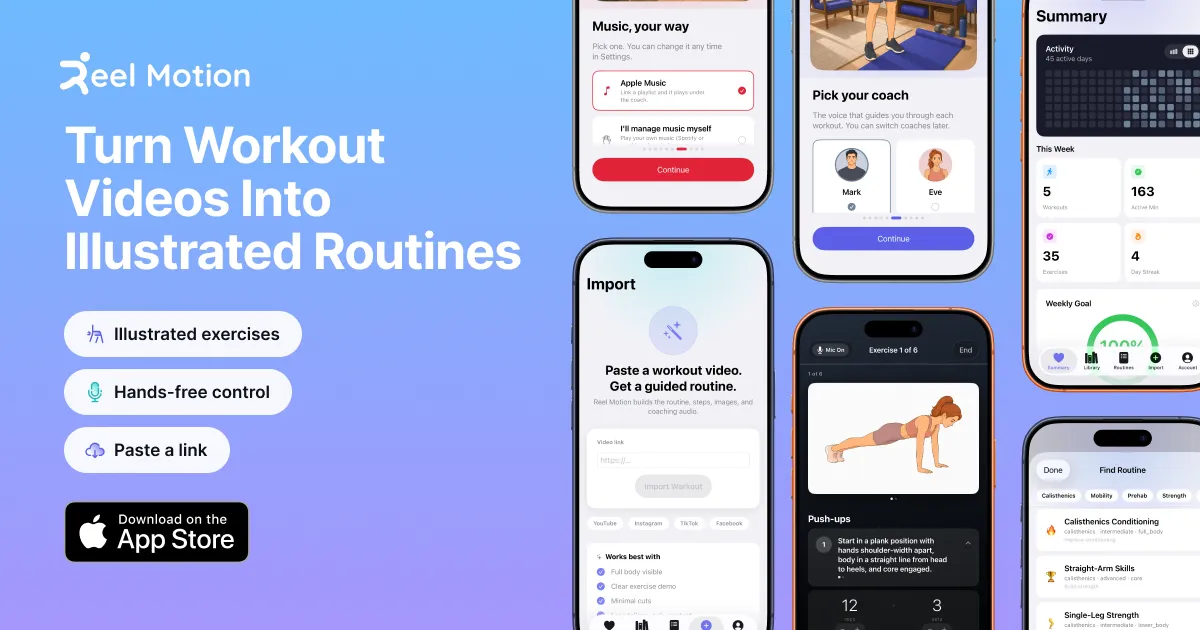
Reel Motion is an iPhone and iPad app built around a narrow, specific friction point: workout videos are made to be watched, not performed. A forty-minute session on YouTube, Instagram, or TikTok is cut for attention rather than for execution, so anyone attempting to train alongside it ends up rewinding, pausing, and scribbling notes between sets. Reel Motion inverts that relationship. It takes a video link, extracts the exercises, and returns an illustrated, step-by-step routine with timers and spoken guidance that runs hands-free from a phone propped against a wall.
Key Features
The feature set is deliberately concentrated on the gap between consuming a video and executing it. Nothing here is a general-purpose fitness tracker; every component serves the import-to-execution pipeline.
- Multi-platform link import. A workout video from YouTube, Instagram, or TikTok is submitted by sharing its link. Reel Motion parses the source and pulls out the exercise sequence, which is the single most labour-intensive part of following along with a creator-led session.
- Illustrated exercise cards. Every movement receives a drawn start position and finish position rather than a frame grab from the original footage. Static illustrations stay legible at arm's length on a gym floor, and the app allows unlimited redraws so a poorly rendered move can be regenerated.
- Hands-free voice control. Commands such as start, next, and done advance the routine. The phone can remain on the floor, which matters when both hands are occupied and a mid-set tap would break position.
- Coach audio. A synthesized coach reads each step aloud while music continues playing underneath, so the guidance layer does not compete with a playlist.
- Guided player. One exercise is displayed at a time with step-by-step instructions and a running timer, replacing the pause-scrub-rewind loop that video playback forces.
- Apple HealthKit integration. Completed sessions are written directly to Apple Health, so activity rings, move goals, and third-party health dashboards stay current without a second logging step.
- Routine library. Users can browse routines imported by other people or assemble one from scratch, which turns a personal collection of saved links into something closer to a shared catalogue.
- Progress tracking. Weekly minutes, streaks, and full session history are surfaced in-app, giving the subscription a measurable output beyond the import itself.
- iPhone and iPad sync. Routines move across devices, allowing a phone to serve as the floor-level player while an iPad acts as the planning surface.
The consistent thread is that the product treats the video as raw material and the routine as the deliverable. That distinction is what separates it from bookmarking tools and from fitness apps that expect users to log sets manually.
How It Works
The workflow is short by design, and the site documents it as three steps.
Step one — paste a link. A workout video is shared into the app from YouTube, Instagram, or TikTok. Reel Motion reads the footage and identifies the exercises, which removes the manual transcription that normally precedes any attempt to repeat a video workout.
Step two — run the workout. The generated routine is played back one exercise at a time. Each card carries illustrations, step-by-step instructions, and a timer, with the coach calling the transition. Voice commands handle advancement, so the sequence continues without physical interaction.
Step three — track progress. After the session, weekly minutes, streaks, and history are recorded and the completed workout is pushed to Apple Health.
Behind that sequence is an interpretation layer doing the heavy lifting. Exercise recognition from unstructured video is genuinely difficult — camera angles change, reps are cut mid-motion, and creators frequently mix compound movements into single blocks. Reel Motion's answer is to present an illustrated abstraction rather than a video clip, which means the output is a normalized routine rather than a re-edited video. The benefit is readability; the trade-off is that the illustrations, not the original coach, define the form cues.
For anyone evaluating the app before committing, the feature breakdown on the homepage maps each of these capabilities to a specific screen, and the support page covers the practical setup questions that come up during the first import.
Use Cases
The product targets a fairly wide band of people, but the fit is sharpest in a few scenarios.
- Home exercisers following creator workouts. Someone who has saved months of YouTube training videos but rarely completes them gets a followable structure without abandoning the creators they already trust.
- Gym and studio training. A phone on the floor with voice-advanced steps solves a genuine ergonomic problem: nobody wants to touch a screen with chalked or sweaty hands between sets.
- Travel and hotel sessions. Short imported routines can be run in a small space without a laptop or a stable streaming connection, since the routine itself is lightweight.
- Rehabilitation and low-impact work. Illustrated start and finish positions are easier to check against than a moving reference, which helps users who need to verify range of motion rather than match a tempo.
- People rebuilding a routine after a break. Streaks and weekly minutes give a lightweight accountability signal without the overhead of a full training log.
- Households. Family plans share access with up to six people through Apple Family Sharing, so a single subscription can cover several training styles — a detail noted in the pricing section.
- Routine browsers. Users without a backlog of saved videos can start from the shared library or build a routine manually, which lowers the cold-start barrier that import-only tools usually have.
A secondary audience is anyone who writes about or teaches fitness. The Reel Motion blog and the published Fair Use policy suggest the team is aware that turning third-party video into structured routines raises legitimate questions about creator rights, and the answer — an abstracted, illustrated routine rather than a re-hosted video — is at least a defensible position.
Pricing & Value
The pricing model is a straightforward three-tier subscription, and notably every tier unlocks the entire application. There is no feature gating between levels, which is an unusual and consumer-friendly choice in a category that often reserves imports or coach audio for the top plan.
- Weekly — $4.99 per week. Positioned for a single training block rather than long-term use.
- Monthly — $19.99 per month. Month-to-month with no commitment, but the least efficient per-day rate of the three.
- Annual — $59.99 per year. Roughly $5.00 per month, advertised as a 75% saving against the weekly rate.
Every plan includes unlimited video imports, illustrated exercises for each step, unlimited illustration redraws, the guided player with step-by-step instructions, coach audio with hands-free control, and iPhone-to-iPad sync.
Value depends entirely on import frequency. The annual tier effectively costs one fast-casual lunch per month, and for anyone importing several videos a month the illustrated abstraction and Apple Health logging justify it comfortably. The weekly tier, by contrast, is priced as a trial or a short project, and a user who stays on it for a full year pays roughly four times the annual rate — a gap worth calculating before subscribing. The family option, starting at $7.99 per week for up to six people, is the strongest per-person economics available and is routed through Apple Family Sharing rather than a separate account system.
Final Verdict
Reel Motion solves a real and oddly underserved problem. Video workout consumption is enormous, completion rates are not, and the reason is structural: the medium is built for watching. Converting a link into an illustrated, timed, voice-advanced routine is a sensible reframing, and the surrounding details — HealthKit writes, iPad sync, a shared routine library — show the team thought past the demo and into routine use.
The honest caveats are platform scope and price. There is no Android, web, or watchOS client, so the app is a dead end for anyone outside Apple's ecosystem. The subscription has no free tier and no one-time purchase, and the weekly rate is steep enough that the annual plan is the only economically rational choice for sustained use. The testimonials published on the site are explicitly labelled placeholders, which is unusually honest but leaves social proof unavailable — and the accuracy of exercise extraction on unusual, non-English, or heavily edited videos remains an open question that only hands-on testing resolves.
For iPhone and iPad users who already hoard saved workout videos and rarely complete them, Reel Motion is a well-targeted fix with a clear job to do. For Android users, or anyone who prefers a simple training log over guided playback, it is not the right tool yet.
Pros
- Imports workout videos directly from YouTube, Instagram, and TikTok links, removing the manual transcription step that normally precedes repeating a creator-led routine.
- Generates illustrated start and finish positions for every exercise, with unlimited redraws, so form can be checked at a glance instead of by scrubbing video.
- Voice commands (start, next, done) and spoken coach audio let the routine advance hands-free while music keeps playing underneath.
- Finished sessions write straight into Apple HealthKit and sync across iPhone and iPad, keeping activity history consolidated without a second logging step.
- A shared routine library plus a from-scratch builder means new users are not dependent on having a backlog of saved video links.
Cons
- The app is iOS and iPadOS only, with no Android, web, or watchOS client, which excludes a large share of the fitness market.
- Access is subscription-only with no free tier or one-time purchase, and the weekly rate of $4.99 is expensive enough that the annual plan is the only sensible long-term option.
- Testimonials on the site are explicitly marked as placeholders and there is no published detail on how reliably exercises are extracted from heavily edited or non-English videos.