Hot Remote Jobs
Hot Remote Jobs is a free, no-signup remote job board that aggregates 60,000+ daily-curated postings with faceted filters for region, timezone, seniority, job type and industry, routing applicants straight to each employer's careers page.
About Hot Remote Jobs
Introduction
Hot Remote Jobs takes a deliberately austere approach to the job board problem. There is no account layer, no membership tier, and no paywall between a candidate and a listing. The site aggregates roughly 60,000 remote postings, refreshes them on a daily cadence, and hands the applicant off to the hiring company's own careers page rather than funneling the application through its own ATS. Coverage spans engineering, product, design, marketing, data and operations, and the filtering model leans on structured facets — region, timezone, seniority, job type and industry — instead of a single keyword box.
Key Features
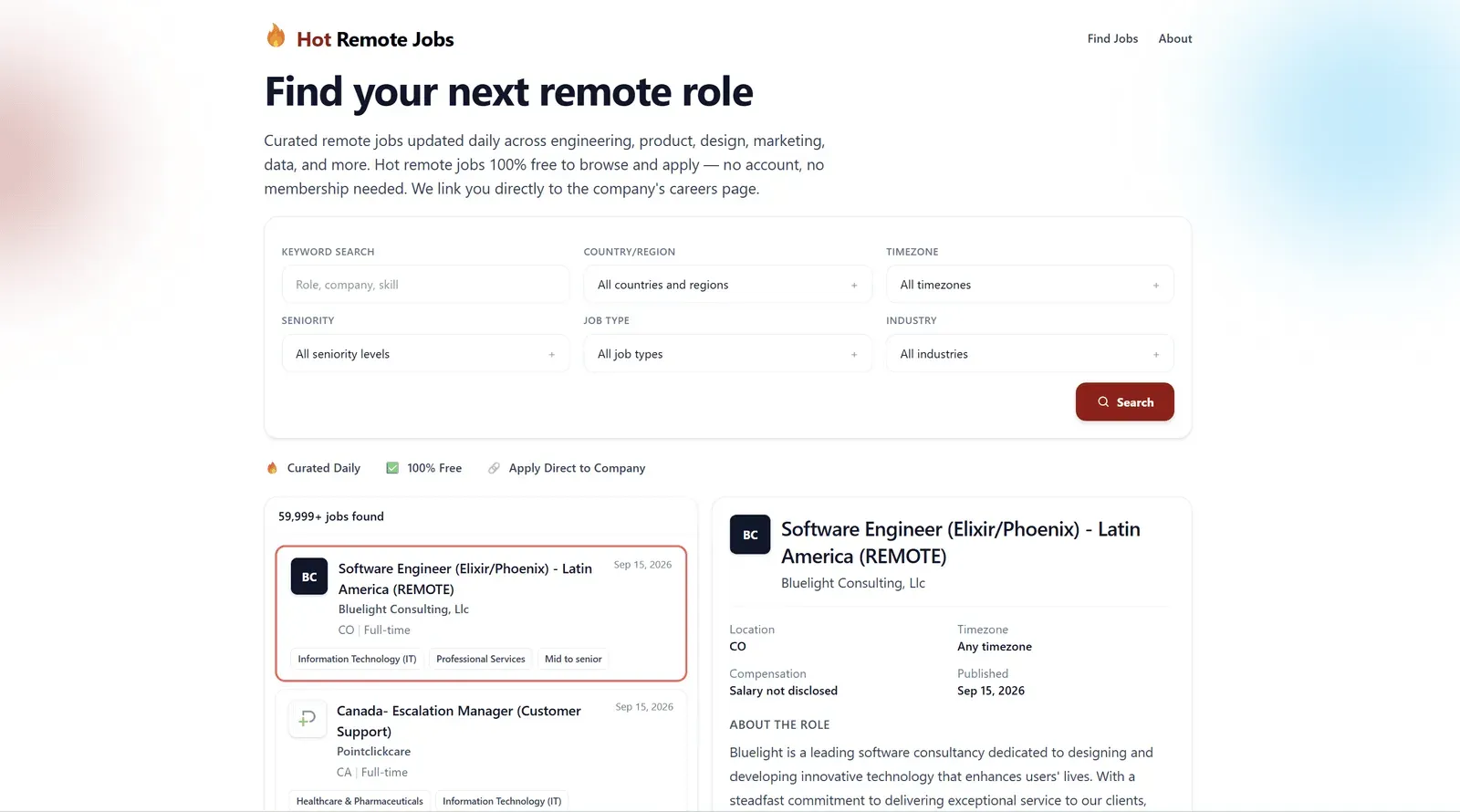
Daily-curated inventory at scale. The interface reports 59,999+ results and labels each card with an explicit publication date, which makes recency a first-class signal rather than something buried in the detail view. Because the pipeline runs daily, the board behaves more like a feed than an archive.
Smart Filters with five independent facets. A single filter panel exposes:
- Keyword search across role title, company name and skill terms
- Country/Region targeting, including dedicated slices for the US, Europe and worldwide
- Timezone matching, so overlapping working hours can be enforced before an application is written
- Seniority bands, from individual contributor through mid-to-senior and leadership
- Job type (full-time and adjacent contract categories)
- Industry classification spanning IT, professional services, banking and finance, biotechnology, healthcare, retail, entertainment and media
Direct application routing. Each listing links to the employer's own posting. There is no intermediary resume parser, no mandatory profile completion, and no step where the candidate must re-enter a work history that already exists in a PDF.
Human-readable listing cards. Every card surfaces company, region, employment type, publication date and a short abstract, so a scan of twenty results produces a usable shortlist without opening twenty tabs.
Role and location landing pages. The footer exposes a structured taxonomy — dedicated pages for remote software engineering roles, product management, product design, DevOps and cloud engineering, AI prompt engineering, growth and paid media, plus location hubs for Europe, the US and worldwide. These pages are indexable and directly linkable, which is useful for anyone tracking a specific discipline rather than a general feed.
Optional resume distribution. Some listings offer an assisted forwarding path that pushes a resume toward hiring managers alongside the standard direct link — an opt-in convenience layer rather than a requirement.
Salaried transparency where the source allows it. Compensation is rendered in a structured definition list on the detail view when the employer publishes it, as seen on roles quoting figures in the $130,000-per-year range.
How It Works
The workflow is intentionally short. A visitor lands on the homepage, encounters a single headline plus a filter panel, and immediately sees a result set — the initial paint hydrates with a progressive loading state before the first ten listings render. There is no interstitial, no email capture, and no onboarding questionnaire.
Filtering is stateful and combinable. Choosing a region narrows the set to that geography, applying a timezone constraint removes roles that would require unsociable overlap, and layering a seniority band and industry on top typically collapses 60,000 postings into a shortlist measured in dozens. The list view shows a live result counter alongside a lightweight pagination control, so the effect of each added filter is immediately legible.
Selecting a card expands an inline detail panel with the structured metadata block — location, timezone, compensation, publication date — followed by an "About the role" excerpt and two actions: a direct apply link and, where offered, the resume-forwarding option. The full-detail route provides a stable, shareable URL per posting.
Because listings point outward to employer ATS systems, the experience after clicking apply is whatever the company runs. That keeps the board thin and fast, but it also means there is no unified application tracker on the platform side. The about page frames the service as a discovery and routing layer rather than a recruiting suite, which is consistent with the product surface.
Use Cases
Senior engineers running a targeted search. A staff-level developer who wants European remote work with a four-hour overlap window can combine region, timezone and seniority in a single pass and skip the noise entirely. The remote jobs in Europe hub gives a pre-filtered starting point.
Specialists in narrow disciplines. Prompt engineering, DevOps and paid-media growth roles each get their own taxonomy entry, which suits candidates whose titles do not map cleanly onto generic "engineering" or "marketing" buckets.
Non-technical remote candidates. Listings on a single page span accounting, legal, plumbing, SEO and biology-adjacent AI training work, so the board is not exclusively a software marketplace even though its keyword metadata leans that way.
Time-zone-sensitive job seekers. For candidates outside US and European hubs, the explicit timezone facet is the difference between a viable role and a permanently awkward schedule.
Recruiters doing market reconnaissance. Aggregated, dated postings with company names and industry tags give a rough read on which sectors are hiring remote, though the board is consumer-facing and offers no employer analytics.
Pricing & Value
The economics are unambiguous: browsing, filtering and applying are free, with no account, no membership tier and no paywall anywhere in the flow. Value therefore depends on opportunity cost rather than subscription cost. Against paid aggregators that charge for early access or resume boosts, the trade is straightforward — the candidate gives up alerting, tracking and application analytics, and in exchange gets unrestricted access to a large, dated pool of postings and a direct line to employer career pages.
There is a secondary value layer in the taxonomy itself. The role and location hubs are indexable, so repeat searches for a specific discipline or geography can be bookmarked and revisited without rebuilding filters from scratch.
Final Verdict
Hot Remote Jobs is a utility, not a platform. It does one thing — surface a large, freshly dated set of remote roles and get out of the way — and it does that thing competently. The five-facet filter model is the strongest part of the product, the direct-to-employer routing is honest, and the absence of a sign-up wall removes the single biggest friction point in most job boards.
The limitations are structural rather than cosmetic. There are no saved searches, no alerting, no application tracking, and no employer-side posting flow, so anyone who wants a managed job-search pipeline will still need a second tool. Result quality also varies with the underlying sources: identical roles posted across multiple countries, such as the same AI-trainer position listed separately for Chile and Denmark, inflate counters without adding distinct opportunities.
For candidates who treat remote job hunting as a recurring scanning habit rather than a managed campaign, the board earns a place in the bookmarks bar. For anyone who needs alerts, CRM-style tracking and employer analytics, it works best as one input among several.
Pros
- Complete search-and-apply flow is available without an account, membership or paywall, removing the main friction point of most job boards.
- Inventory depth is significant, with 59,999+ remote listings refreshed daily across engineering, product, design, marketing, data and non-technical functions.
- Smart Filters combine keyword, country/region, timezone, seniority, job type and industry facets, allowing 60,000 postings to be narrowed to a precise shortlist.
- Every listing routes candidates directly to the employer's own careers page rather than an internal application funnel, preserving a single application process per company.
- Dedicated indexable role and location hubs (software engineer, DevOps, prompt engineer, Europe, US, worldwide) support repeatable discipline- or geography-specific searching.
Cons
- No native saved searches, email alerts or digest subscriptions, so a search cannot be automated or monitored passively.
- Employers cannot self-serve publish listings — the board is purely an aggregation and routing layer with no posting or applicant-management side.
- Near-duplicate roles posted across multiple countries (for example the same AI-trainer position listed separately for Chile and Denmark) inflate the result counter without adding distinct opportunities.