GeckoStats
GeckoStats wires Stripe, Polar, Creem and Dodo Payments webhooks into cookieless visitor records, so traffic sources, search queries and AI crawlers carry revenue figures instead of vanity pageviews.
About GeckoStats
Overview
GeckoStats is a web analytics service that measures traffic against revenue rather than against itself. Instead of reporting sessions, bounce rates and pageviews in isolation, it wires a payment provider's webhook into the visitor record created on the first pageview, so every source, campaign, landing page, search query and AI crawler eventually carries a monetary figure beside its visit count. The pitch is deliberately narrow: know which traffic brings paying customers.
The product sits in the privacy-first, cookieless analytics segment, a field already occupied by Plausible, Fathom, Simple Analytics, Umami and DataFast. GeckoStats acknowledges that crowding rather than pretending it does not exist — the site publishes head-to-head comparison pages against all five rivals, each framed as a two-way assessment that names what the competitor does better. Differentiation rests on two pillars: revenue attribution baked into the core data model rather than bolted on through a Zapier chain, and a Model Context Protocol server that exposes the same figures to AI agents.
Founding date, headcount, funding and customer counts are not disclosed anywhere on the page. Pricing is public, starts at $17 per month and scales by event volume, which points at an indie or small-team operation courting solo founders, newsletter operators and early-stage SaaS companies rather than enterprise marketing departments.
Key Features
Revenue attribution built on payment webhooks. Stripe, Dodo Payments, Polar and Creem each connect through a single webhook, and any other billing system can report an amount plus a visitor identifier through one API call. Attribution runs through a documented fallback chain — checkout visitor id, return page, the customer's prior payments, an identified email, then checkout timing — and the dashboard states which method matched each sale. Credit defaults to the last visit from a real source, so a tweet keeps the sale even when the buyer returns directly two weeks later.
Click-level customer journeys. Opening any customer reveals location, device, operating system, browser, first source, visit count, total spend and time-to-first-payment. Below that sits a chronological timeline of pages, goals and payments, with session durations and campaign tags attached to each entry. It reads closer to a lightweight CRM record than to a typical analytics report.
Search Console queries priced by earnings. A one-time OAuth connection pulls every query, page and country the site ranks for, and the table sorts by attributed revenue instead of impressions or volume. Values carry an approximately-equal symbol because Google never ties a query to a person, and pages are priced only once they have traffic. The same view flags queries losing clicks at an unchanged position and reports what Google's index says about the pages that earn.
AI crawler read-versus-return reporting. Crawlers execute no JavaScript, so a tracker script cannot see them; GeckoStats records server-side what GPTBot, ClaudeBot, PerplexityBot and Gemini fetch, then lines that against the visitors those same services later referred and the revenue those visits produced. The table answers a question most analytics tools cannot: what did AI take from the site, and what came back.
MCP server with 26 read-only tools. Developers add the server with a single terminal command or a custom connector, then query overview, sources, pages, campaigns, goals, funnels, customers, search queries, releases and live view from Claude, Claude Code, ChatGPT, Cursor, Gemini CLI, Grok or any MCP client. Keys are issued per website and revocable at any time; the tools read only and cannot alter settings.
Live globe and event stream. A real-time map shows everyone on the site at that moment alongside a feed of pageviews, goals and payments as they land, with the referring service named on each row. The site mentions an optional sound for each sale — a novelty, but a practical one during a launch window.
Campaign tagging with delayed credit. A tagged link per tweet, article, newsletter issue or podcast episode appears by name with both visitors and revenue, and conversions still attribute when the purchase happens weeks later. Last-click is replaced by a rule that prefers the most recent non-direct source, which is what makes social campaigns measurable at all.
Goals, funnels, subscriptions and retention. Button clicks and signups become goals, funnels show step-by-step drop-off, and MRR, churn and lifetime value can be sliced by acquisition source. Release markers, tracking-failure alerts, week-by-week retention cohorts and PNG exports of any period round out the operational set, all included on both plans.
Cookieless tracking under 7 KB. The script is 6.6 KB gzipped with no dependencies and loads after the page. Visitors are salted hashes of IP, user agent and site that rotate daily; the IP itself is never stored, so no consent banner is required by default. A per-site cookie mode exists for teams that need cross-day identity.
How It Works
Setup begins with a site entry in the dashboard, which issues a tracking snippet and a per-site API key. The snippet sits in the page head or loads asynchronously, and the company claims no measurable performance impact given the 6.6 KB footprint. A typical deployment then calls identify() with the email of a signed-in user, which is the anchor later reconciliation relies on when a checkout loses its visitor id.
Payment attribution is the second step. Teams register a webhook in Stripe, Dodo Payments, Polar or Creem — the Stripe integration documents a single endpoint and signing secret — or post to the payments API directly. From that point onward a completed checkout arrives with an amount, a timestamp and a visitor reference, and the dashboard backfills the revenue column on every source, campaign, page and query it can reach.
Search visibility requires a third connection: an OAuth handshake with Search Console. The tool deliberately reads Google's existing index rather than running its own crawler, which keeps setup light but also means no keyword data for pages Google has not yet indexed.
Everyday use happens across six screens: overview, channels and campaigns, customers, search, AI crawlers and live view. Clicking any row — a source, a country, a campaign, a query — filters the entire dashboard to that slice, so the drill-down from a revenue spike to a specific tweet is a two-click operation. Agents retrieve the same slices programmatically once the MCP server is registered; the documentation shows a single claude mcp add invocation with a bearer token and no further plumbing.
Monitoring is the final layer. Alerts fire when tracking stops, revenue drops, organic clicks fall, a page is deindexed or a query loses five positions, and a curl call at the end of a deploy drops a marker on the chart so a traffic dip can be read against what shipped.
Use Cases
Solo SaaS founder validating channel bets. A founder paying $17 a month runs three acquisition channels simultaneously — X posts, a newsletter mention, a handful of search pages. After two weeks the dashboard shows a newsletter driving 388 visitors and $245, a launch tweet driving 612 visitors and $497, and an Instagram reel driving 1,120 visitors and $98. Dropping the reel and doubling the newsletter becomes an obvious call rather than a spreadsheet exercise.
Newsletter operator with a long consideration cycle. Readers rarely subscribe on the first click. Tagged links per issue let the operator see which issue actually preceded payment three weeks later, because attribution prefers the most recent non-direct source. The retention view then reveals whether subscribers from a particular issue stay past month two.
Developer working inside an AI editor. A team already using Cursor or Claude Code adds the MCP server and asks the agent to summarise last week's traffic against revenue without leaving the editor. Because the server returns the same rows the dashboard draws, the answer matches what a human would read, and no CSV export round-trip is required.
Content team with a search-heavy funnel. A company ranks for several commercial-intent queries but cannot tell which ones pay. Connecting Search Console surfaces that a query like "stripe revenue analytics" earned roughly $486 against 142 clicks while "free website analytics" earned nothing against 54 clicks — a prioritisation signal that raw impression data hides completely.
Small studio managing client sites. The Growth plan's 30 sites and 30 seats fit an agency needing per-client dashboards with shared access, provided each client's payment provider is connected separately. Revenue reporting for clients selling one-off services works through the generic payments endpoint.
Pricing & Value
Pricing follows a single slider from 25K to 10M events per month, with two plan tiers layered on top. At the 100K tier, Starter costs $17 per month and covers one site and one seat; Growth costs $35 per month and raises that to 30 sites and 30 seats. Annual billing carries a stated 17% discount. Every tier includes the full feature set — revenue attribution, Search Console, the AI assistant, the MCP server, retention, alerts and exports — so the upgrade decision is about seats and site count, not about gated functionality, which is a cleaner model than most competitors' feature-locked tiers.
An event is defined as a pageview, a goal, or a payment. Crawler hits are metered separately and do not consume quota, an important detail for sites that attract heavy AI scraping. Overages do not truncate data: the dashboard keeps counting and a note suggests the next tier, with a request to move up after two consecutive months over the limit. Prices exclude VAT, which may be applied at checkout.
Figures should be verified at the pricing page, since the slider changes the number at every tier. Value assessment: $17 for 100K events sits in line with Plausible and Fathom, but those tools carry neither payment attribution nor an MCP server, so the price is defensible for anyone selling something. The seven-day trial with no stated commitment makes evaluation cheap, and for a company where revenue attribution replaces a separate BI pipeline the saving dwarfs the subscription.
Who It's For
Best fit is the small commercial site that sells a product: indie SaaS, paid newsletter, course creator, productised service, or a small studio running several of them. The ceiling of 30 seats on Growth suggests a deliberate step below enterprise, and there is no mention of SSO, custom data residency, audit logs or a signed SLA — teams that need those should look at a larger vendor.
The AI-agent angle makes GeckoStats unusually relevant to engineering-led teams already using Claude Code, Cursor or Gemini CLI in daily work; the MCP server turns analytics into something an agent can reason over instead of a dashboard someone has to remember to open.
Teams that should look elsewhere: publishers monetising with display advertising, whose revenue never passes through a payment webhook; anyone needing session recordings, heatmaps or A/B testing, none of which are offered; organisations requiring self-hosting, since no self-hosted distribution is mentioned; and enterprises with procurement processes around SOC 2 or similar certifications, which the site does not disclose.
Final Thoughts
GeckoStats picks a defensible wedge. Most privacy-first analytics tools stop at counting visitors honestly; this one takes the extra step of pricing those visitors, and the fallback chain for attribution is documented rather than hand-waved. The AI crawler report is a genuinely novel view — knowing what GPTBot read and what ChatGPT referred back answers a question that has been guesswork for most site owners — and the MCP server is a forward-looking bet that will age well as agent-driven workflows spread.
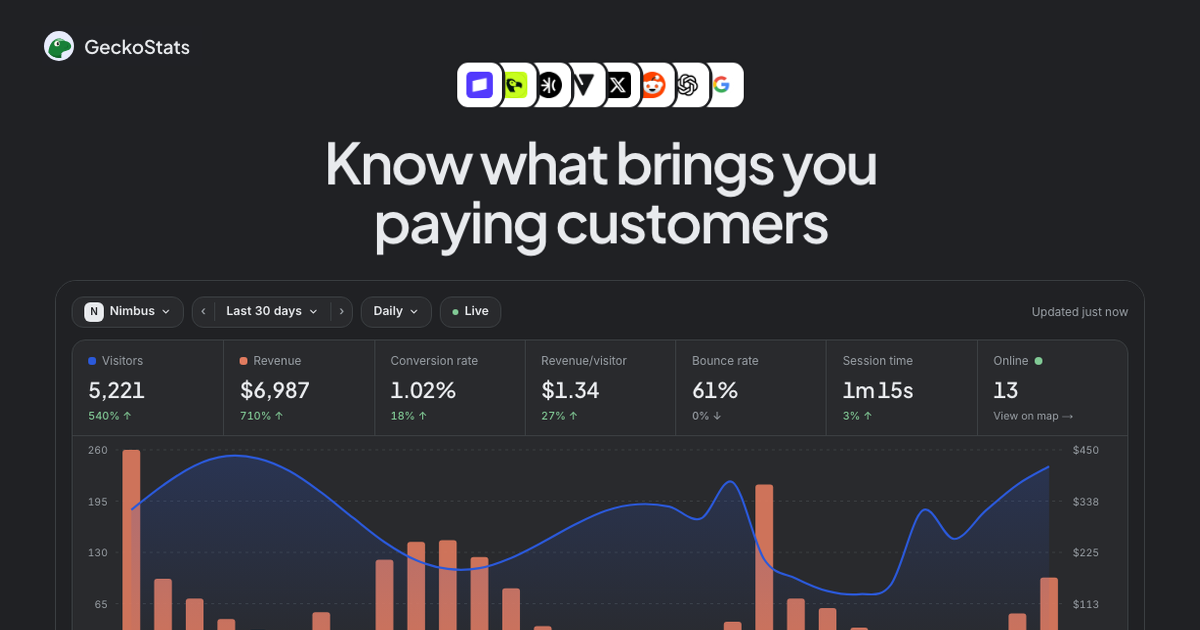
Weak spots are real but bounded. There is no self-hosted option, no session replay, and no certification or compliance detail published. Vendor identity is thin: no team page, no company history, no named customers or case studies, so buyers are trusting a small operation with revenue-linked data. Search attribution remains an estimate by necessity, and the marketing leans on a fictional demo tenant called Nimbus, clearly labelled as sample data but still requiring the reader to separate demonstration from substance.
The recommendation is straightforward for the intended audience. A founder or small team selling subscriptions who currently stitches together GA4, a spreadsheet and a payment dashboard will find the whole loop replaced by one tool at $17 a month. Larger organisations with procurement requirements, or sites monetising through ads rather than payments, should treat it as a niche specialist and keep their existing stack.
Pros
- Payment webhook attribution ties each sale back to the originating tweet, campaign, search query or AI referral, with a documented fallback chain and a visible note on which match method was used.
- An MCP server exposing 26 read-only tools lets Claude, ChatGPT, Cursor, Gemini CLI and Grok query the same rows the dashboard renders, using revocable per-site keys.
- Server-side AI crawler tracking shows what GPTBot, ClaudeBot, PerplexityBot and Gemini fetched and how much revenue those same services later referred back.
- Cookieless by default: a 6.6 KB dependency-free script, salted visitor hashes that rotate daily, no stored IP addresses, and no consent banner required.
- Both plans ship the entire feature set — Search Console pricing, funnels, MRR by source, retention cohorts, alerts and PNG exports — starting at $17 per month for 100K events.
Cons
- No self-hosted distribution and no published compliance detail such as SOC 2, SSO or data-residency options, which limits adoption inside larger or regulated organisations.
- Company information is thin — no team page, funding history, customer count or case studies — so buyers are trusting an unverified vendor with revenue-linked data.
- Search query revenue is inherently approximate, and the absence of session recordings, heatmaps or A/B testing means the tool cannot replace a full product-analytics stack.