erecruit
erecruit maps Australian government ICT tenders to the job ads behind them, giving recruiters evidence-based CV matching and pipeline tools to target real contracts.
About erecruit
Overview
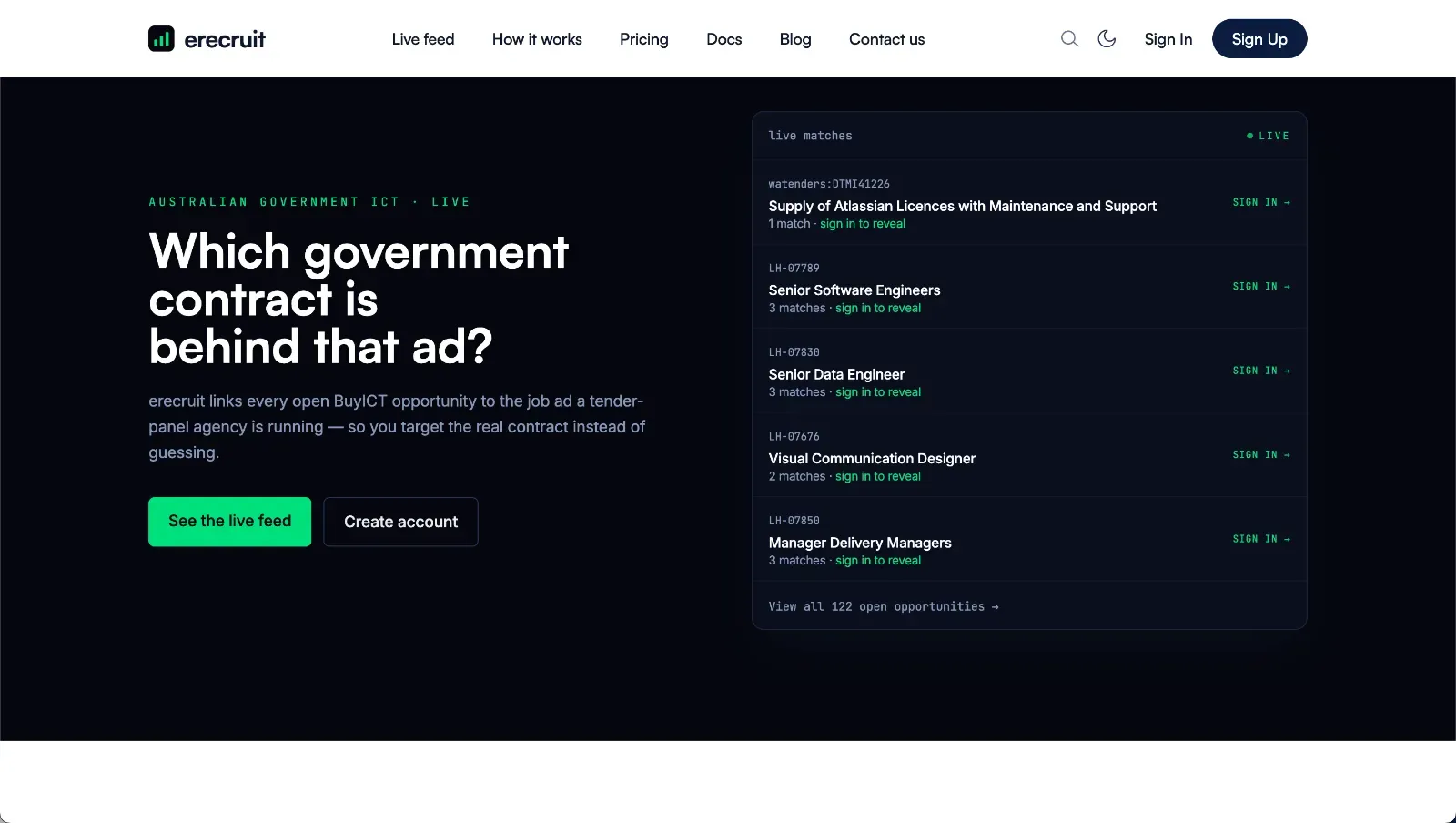
erecruit is a specialized intelligence platform for recruiters targeting Australian government ICT contracts. It aggregates open labour-hire opportunities from BuyICT and links each to the specific job ad published by a tender-panel agency. The system uses evidence-based matching—role, clearance, location, timing—to connect contracts with agency ads. Recruiters can upload CVs to receive scored candidate-role matches, search and import candidates from external sources, and manage a pipeline via kanban stages. A consent gate ensures representation consent is obtained before submission. The platform aims to eliminate guesswork by revealing which contract is behind each ad, enabling targeted candidate placement.
Key Features
- Opportunity intelligence: Every open government ICT opportunity linked to the agency ad behind it.
- CV matching: Scores candidate CVs against each role with evidence.
- Candidate search: Finds and imports candidates from external sources.
- Pipeline kanban: Drag-and-drop stages filtered by opportunity.
- Consent gate: Requests representation consent before submission.
- Recruiter dashboard: KPIs, CV matches, and recent activity.
Pros
- Links every open Australian government ICT opportunity to the specific job ad from a tender-panel agency, eliminating manual cross-referencing.
- Provides evidence-based CV scoring that shows exactly why a candidate matches a role, improving placement accuracy.
- Includes a consent gate to obtain candidate representation consent before submission, reducing compliance risks.
- Features a live feed of open opportunities with real-time match counts, keeping recruiters updated instantly.
- Offers a pipeline kanban that filters candidates by opportunity, streamlining the recruitment workflow.
Cons
- Exclusively focuses on Australian government ICT opportunities, limiting usefulness for other markets or sectors.
- Requires user authentication to reveal matches and access full opportunity details, which may hinder initial exploration.
- Lacks public information about integrations with existing applicant tracking systems or CRM platforms, potentially complicating adoption.