SnitchFeed
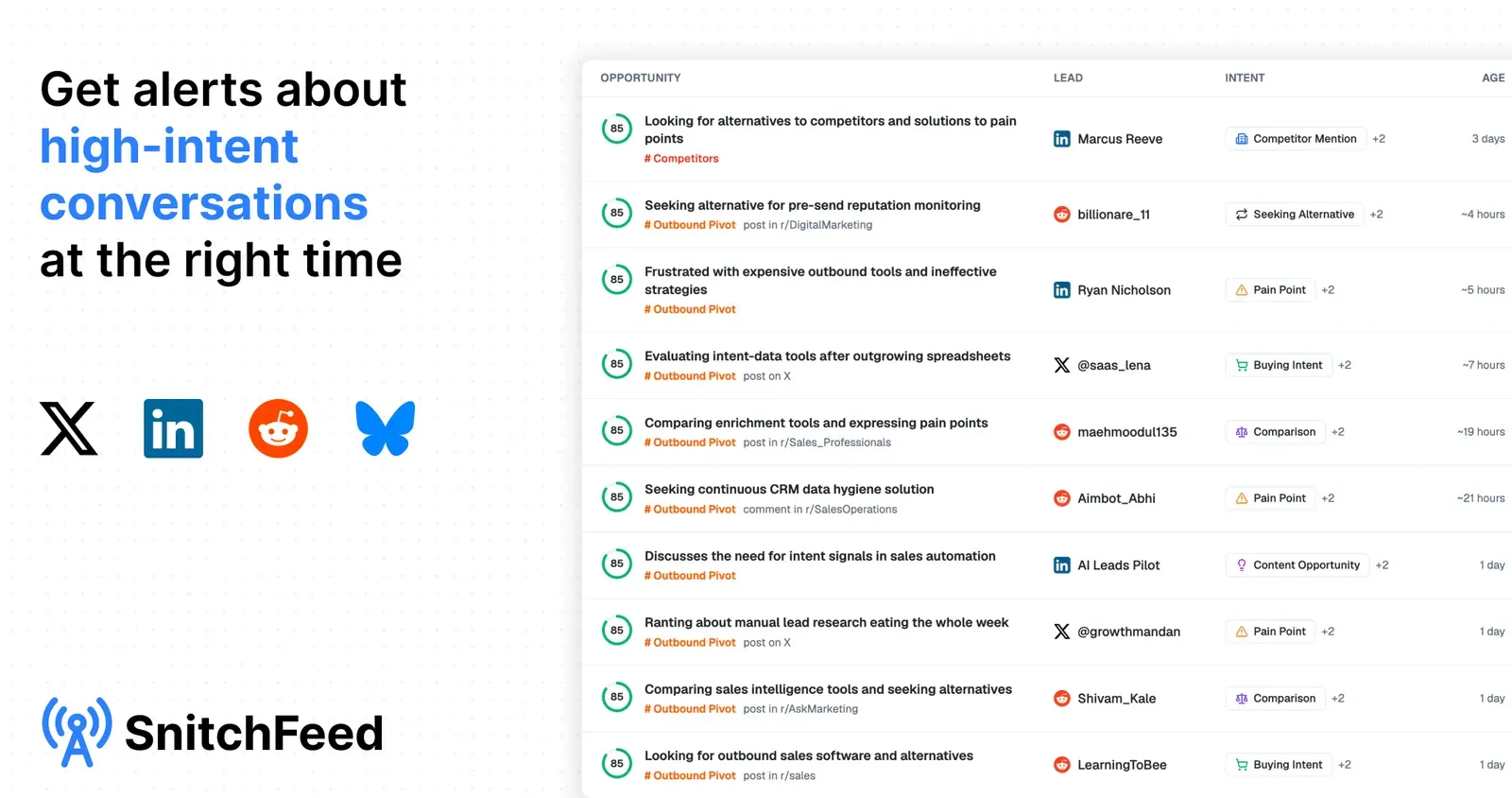
SnitchFeed scans LinkedIn, X, Reddit, Bluesky, and Hacker News for buying-intent conversations, applying AI relevance and sentiment scoring plus Boolean filters before routing qualified leads into Slack, CRM, or any webhook endpoint.
About SnitchFeed
Introduction
SnitchFeed is an intent-based social listening platform aimed at go-to-market teams inside startups and SMBs. Instead of reselling the same static contact databases that most outbound tools depend on, it continuously scans public conversations on LinkedIn, X, Reddit, Bluesky, and Hacker News for language that signals active buying intent. The premise is straightforward: keyword monitoring produces noise, while intent detection produces pipeline. Natural-language ICP descriptions, AI relevance and sentiment scoring, and webhook-driven routing combine so qualified conversations reach a team before a competitor replies.
Key Features
SnitchFeed bundles monitoring, qualification, and delivery into one pipeline rather than selling them as separate modules.
- AI scoring and tagging. Every matched mention is evaluated for relevance, buying intent, and sentiment before it reaches the feed. Keyword hits that are not genuine signals — promotional posts, spam, and off-topic threads — are dropped automatically, keeping the inbox signal-heavy.
- Boolean search controls. Terms can be combined with AND, OR, and NOT operators to describe exact conversational patterns and exclude unwanted ones. Job postings, product promotions, and recurring false positives disappear without manual triage.
- Real-time alerting. Notifications can be delivered by email, Slack, Discord, or outbound webhook. Teams choose between instant pings and digest summaries depending on how fast they need to react.
- Historical backfill. New accounts do not wait for fresh posts. SnitchFeed streams historical data immediately, so the first session surfaces leads that already exist publicly.
- Webhook-first integrations. The Pro tier fires a webhook the moment a match lands, enabling routing into HubSpot, Salesforce, Notion, Zapier, Make, or internal tooling. Any system accepting an HTTP payload can be wired in.
- Noise controls. Domains can be blocked, authors excluded, engagement thresholds applied, and recurring false positives muted permanently.
- API and MCP access. Programmatic access is available on both paid tiers, including MCP support for connecting the data to agent-based workflows.
- Multi-platform reach. Five networks are monitored in production, each with a dedicated source page, while GitHub, dev.to, YouTube, and newsletters are listed as upcoming.
The combination matters more than any single capability. A monitoring tool without scoring floods a Slack channel; a scoring engine without Boolean logic misses niche phrasing. SnitchFeed's value comes from chaining detection, qualification, and delivery into one loop. The full feature breakdown documents each module in detail.
How It Works
Setup follows four steps.
- Describe the ICP. The user writes a plain-language description of the ideal customer — job titles, industries, company profiles, or the phrasing a buyer would naturally use. No query syntax is required at this stage.
- Continuous scanning. Listeners run 24/7 across connected platforms, applying the ICP description and any Boolean refinements to filter matching conversations.
- Notification. Matches arrive with scoring metadata through the chosen channel, either immediately or as a scheduled digest.
- Routing into the GTM stack. Webhooks push qualified conversations into CRMs, sequencing tools, or internal systems for follow-up.
The onboarding claim is aggressive: first leads within 60 seconds and complete setup in roughly five minutes. That is plausible given the historical backfill — a new listener is evaluated against existing posts rather than an empty queue, so results appear almost instantly instead of trickling in as new content is published.
The interface centers on a conversational input box where the ICP is typed, similar to prompting an AI assistant, with quick actions for finding opportunities, tuning listeners, summarizing mentions, and configuring alerts. That framing lowers the technical barrier compared with traditional Boolean-only monitoring tools, where crafting the correct query is half the work. Auto-exclusion rules for job postings, promotions, and noise run behind the scenes.
The help documentation also addresses an often-overlooked question: how mentions are detected when the brand is not tagged. SnitchFeed infers relevant conversations from context rather than relying on @-mentions or hashtags, which is the core mechanism behind competitor-complaint monitoring and untagged brand sentiment tracking.
Use Cases
- Pipeline generation. Posts such as "anyone know a tool that does X?" sit far lower in the funnel than cold outreach targets. SnitchFeed routes those posts to the team before other vendors respond.
- Competitor displacement. Complaints about a rival product are surfaced in real time, letting teams enter the conversation with an alternative while the frustration is fresh.
- Product discovery. Recurring feature requests and workarounds described in public threads become a de facto roadmap input, reducing reliance on guesswork or survey panels.
- Brand and reputation monitoring. Negative mentions can be caught within minutes, giving marketing and support teams a chance to respond publicly before sentiment spreads.
- Sales leadership. Sales leads can monitor for buying signals tied to a specific territory, industry, or competitor without manual prospecting hours.
- Marketing leadership. Content and demand-generation teams can extract the exact language buyers use, then reuse it in campaigns and landing pages.
- Early-stage founders. Pre-launch products can validate demand by observing whether the underlying problem is being discussed before investing in a build.
The platform is explicitly positioned for B2B SaaS and startups, with enterprise needs served only through the custom tier. That suggests the product is optimized for speed of setup over deep governance features. The team also publishes vendor comparison pages, such as comparisons against Octolens, which help evaluators map SnitchFeed against established monitoring incumbents.
Pricing & Value
Three tiers are listed.
- Starter — $47/month billed annually ($564/year), or $59/month monthly. Includes 7,000 credits per month, 10 tracked terms and profiles, 3 listeners, relevance and sentiment scoring, email/Slack/Discord alerts, API and MCP access, 3-month data retention, and a single user. Webhooks and CSV exports are excluded.
- Pro — $95/month billed annually ($1,140/year), or $119/month monthly. Raises limits to 21,000 credits, 30 tracked terms, 10 listeners, 5 users, and 6-month retention, while adding webhook automations plus CSV exports. It carries the "most popular" label.
- Custom — from $399/month. Adds multiple workspaces, custom data pipelines, dedicated integration support, and custom limits.
The stated value argument is that one closed deal covers a year of subscription at the Starter rate. All plans include the same five live platforms, so the differentiators are volume, seats, retention, and automation rather than data access. A 7-day free trial is available on both self-serve plans with no credit card required. Further detail is available on the official pricing page.
Final Verdict
SnitchFeed addresses a real gap: most social listening tools were designed for brand marketers measuring share of voice, not for revenue teams hunting conversations that convert. By scoring intent and pushing matches through webhooks, it behaves more like a signal feed than a reporting dashboard.
Strengths are clear. Five production platforms, AI qualification, Boolean control, historical backfill, and webhook routing form a coherent workflow, and the entry price is low enough for a two-person startup to justify. Setup burden is minimal because ICPs are written in natural language rather than query syntax.
Limitations are equally clear. Four announced sources remain in "soon" status, so coverage is narrower than the marketing implies. There is no permanent free tier, and the Starter plan omits webhooks and CSV exports — the very features that make the product useful for automated routing. Tracked-term caps of 10 and 30 may be restrictive for agencies managing many brands or competitors simultaneously, and credit-based limits introduce a variable that heavy users will need to model before committing to an annual plan.
Overall, SnitchFeed is a strong fit for seed-to-Series-B B2B startups with a defined ICP and at least one person able to respond to leads quickly. Teams needing enterprise-grade governance, multilingual sentiment analytics, or immediate coverage of developer platforms may prefer to wait for the roadmap to ship. For lean GTM teams, the trial is worth running against a live competitor keyword set to verify signal quality before buying.
Pros
- Monitors five live networks — LinkedIn, X, Reddit, Bluesky, and Hacker News — from one dashboard instead of requiring a separate keyword tool per platform.
- AI scoring grades relevance, buying intent, and sentiment before delivery, dropping promotional posts, job listings, and off-topic keyword hits automatically.
- Historical data is streamed at signup, so the first qualified matches appear within roughly 60 seconds rather than waiting for new posts to accumulate.
- Webhook-first architecture on the Pro tier routes matches into HubSpot, Salesforce, Notion, Zapier, Make, or any custom endpoint without native connectors.
- Boolean AND/OR/NOT operators combine with domain blocking, author exclusions, and engagement thresholds for precise control over signal quality.
Cons
- GitHub, dev.to, YouTube, and newsletter monitoring are still marked "soon," so real coverage is narrower than the platform list suggests.
- No permanent free plan exists, and the Starter tier omits webhooks and CSV exports — the automation features that make the product most useful.
- Tracked terms are capped at 10 on Starter and 30 on Pro, which can constrain agencies monitoring many brands or competitors at once.