
Case Cub
Case Cub provides law students with a unified study suite featuring an expansive case brief database, AI-generated quizzes, spaced-repetition flashcards, and an interactive legal assistant.
About Case Cub
Introduction
Case Cub is an AI-powered legal study platform built specifically for law students. It combines a vast repository of over 20,000 interactive case briefs with advanced study tools such as smart flashcards, custom quiz generation, and a 24/7 AI chat assistant. Designed to streamline the demanding workflow of law school, Case Cub aims to replace fragmented study resources with one comprehensive, searchable platform. For students juggling heavy reading loads and exam preparation, this platform offers a structured way to digest case law and reinforce knowledge through active recall and spaced repetition. The following review examines its core features, usability, practical applications, and overall value for legal education.
Key Features
Comprehensive Case Brief Library
The cornerstone of Case Cub is its extensive case brief collection. With over 20,000 briefs spanning from the 1600s to present-day decisions, the database covers a wide range of subjects typically encountered in law school curricula. Each brief is formatted to highlight essential components such as facts, procedural history, issues, holdings, and reasoning. This structured approach enables students to quickly grasp the key points of a case without wading through lengthy opinions. The platform also provides access to full case opinions, with smart navigation that allows users to jump between the brief and the original text seamlessly. Interactive elements further enhance understanding by making the briefs more engaging than static text.
AI-Powered Quiz Studio
The Quiz Studio feature leverages artificial intelligence to generate custom quizzes from any legal material. Users can input their own notes, case briefs, or textbook excerpts, and the system creates questions designed to test comprehension and application. Multiple question types—including multiple-choice, true/false, and short answer—provide a well-rounded assessment. Performance tracking and analytics help students identify weak areas, while a timed practice mode simulates exam conditions, which is particularly valuable for preparing for finals or the bar exam. The instant generation of relevant questions saves hours of manual study preparation.
Smart Flashcard System
Case Cub's flashcard system incorporates proven spaced repetition algorithms to optimize memory retention. Users can create custom decks organized by course or topic, or generate flashcards automatically from their study materials. The AI analyzes the content to produce high-quality question-and-answer pairs, eliminating the time-consuming task of manual card creation. Progress tracking across subjects allows students to see which decks need more attention, and the spaced repetition schedule ensures that concepts are reviewed at optimal intervals for long-term retention. This feature is particularly useful for memorizing legal terminology, rules, and case holdings.
Interactive Cub Chat
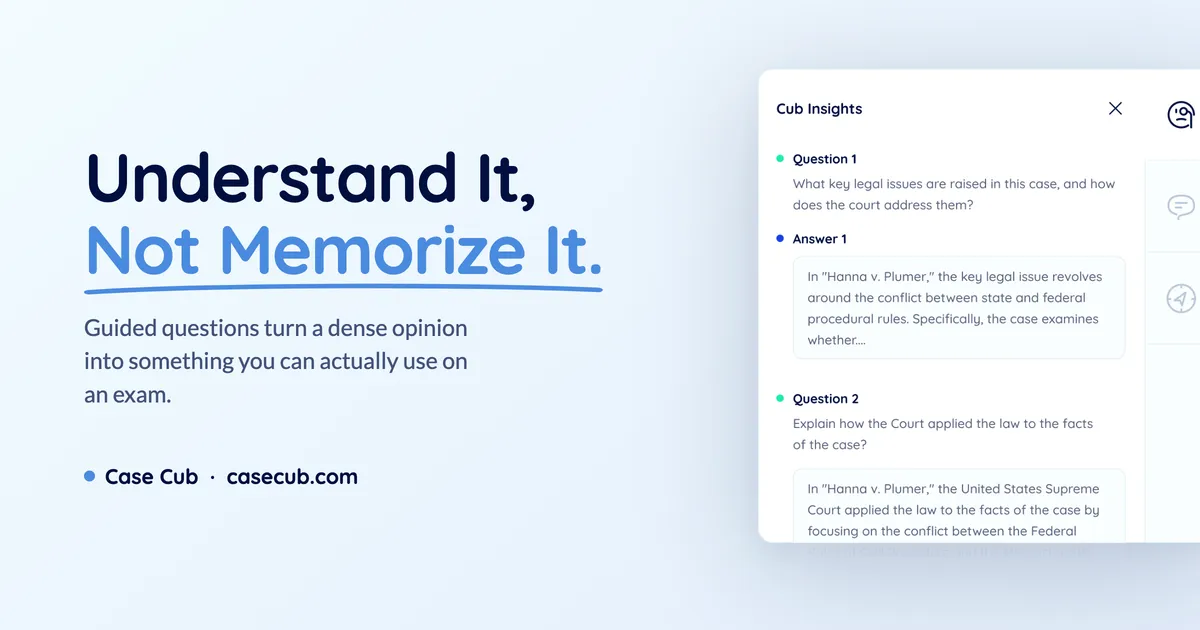
The Cub Chat is an integrated AI assistant available around the clock. It can answer legal questions, explain complex principles, and provide contextual insights into specific cases. Unlike generic chatbots, Cub Chat is trained on legal content, making it capable of offering citation assistance, verifying legal references, and diving deep into case specifics. For students stuck on a nuanced doctrine or needing clarification on a reading, this feature serves as an instant tutor. The conversational interface makes it easy to ask follow-up questions and explore topics iteratively, which is invaluable for self-directed learning.
Additional Study Aids
Beyond the headline features, Case Cub includes comprehensive outlines and progress-tracking tools. The platform's design as an all-in-one hub means students can transition from reading briefs to creating flashcards to taking quizzes without switching between different apps. The unified dashboard provides a clear overview of study activity, making it easier to plan and monitor progress. For exam preparation, the combination of practice questions and structured outlines offers a systematic approach to review.
How It Works
Getting started with Case Cub is straightforward. After signing up for a free trial, users land on a dashboard where they can immediately search the case library, browse outlines, or access any of the study tools. The case library is searchable by case name, citation, subject, or keyword, allowing for rapid lookup during study sessions or open-book exams. Each case brief is displayed in a clean, readable format with interactive elements that can be toggled to reveal additional information.
The Quiz Studio workflow involves selecting or uploading study material, choosing the desired question types and quantity, and then generating the quiz. The system processes the content and produces a set of questions in seconds. After completing a quiz, users receive immediate feedback with explanations for both correct and incorrect answers, reinforcing the learning process.
The flashcard system integrates with the user's course materials. Students can create a new deck, input or paste their notes, and let the AI generate flashcards. The spaced repetition algorithm then schedules reviews based on the user's performance, optimizing study time.
Cub Chat is accessible from any page on the platform. Clicking the chat icon opens a conversation window where users can type questions or requests. The AI responds with detailed explanations, citations, and links to relevant cases or briefs, creating a seamless learning loop.
Use Cases
First-Year Law Students (1L)
1Ls face the challenge of reading hundreds of cases each week while learning the fundamentals of legal analysis. Case Cub's concise, well-structured briefs allow them to quickly identify the holding and reasoning of a case, freeing up time for developing the critical thinking skills required in class discussions. The AI chat is particularly helpful for demystifying unfamiliar concepts like personal jurisdiction or the rule against perpetuities.
Upper-Level Students Preparing for Exams
For 2L and 3L students focusing on exam preparation, the Quiz Studio and flashcards are powerful assets. Custom quizzes can be generated from class notes and case briefs, providing targeted practice on the specific topics likely to appear on finals. The timed mode helps students build speed and accuracy, while performance analytics reveal which subjects need extra review. Spaced-repetition flashcards ensure that key rules and case names are committed to memory well before exam day.
Students with Limited Study Time
Law students often juggle classes, extracurriculars, and part-time jobs. Case Cub's all-in-one approach saves time by eliminating the need to maintain separate study resources. Instead of manually writing case briefs, students can rely on the comprehensive briefs available on the platform. The AI-generated quizzes and flashcards turn passive reading into active learning, making every study session more efficient. This is especially valuable for those who need to maximize productivity during limited study windows.
Open-Book Exam Preparedness
Many law school exams are open-book, so having a searchable database of case briefs is a game-changer. Instead of flipping through tabbed casebooks, students can search for a specific case or issue in seconds and access a clear summary. The ability to filter by subject or time period further enhances quick retrieval during the pressure of an exam.
Pricing & Value
Case Cub offers a free trial that grants full access to all features, allowing prospective users to evaluate the platform before committing. While the homepage does not list specific pricing tiers, the subscription model is designed to be flexible, with no long-term commitments and the ability to cancel at any time. The value proposition is strong when compared to the cost of traditional study aids such as commercial case briefs, flashcards, and tutoring services. With 20,000+ case briefs and AI tools, the platform consolidates multiple resources into one subscription, potentially saving law students both money and time. For those interested in current pricing, the pricing page provides detailed information.
Final Verdict
Case Cub is a robust and thoughtfully designed study companion for law students. Its extensive case brief database, combined with AI-driven quizzes, flashcards, and a knowledgeable chat assistant, addresses the core challenges of legal education: understanding cases, retaining rules, and applying them under exam conditions. The platform's intuitive workflow and all-in-one architecture make it a practical choice for busy students who want to study smarter, not harder.
However, it is important to note that Case Cub is specifically tailored to law school coursework, so practicing attorneys or those outside legal education may find limited value. Additionally, as with any AI-generated content, there is a potential for occasional inaccuracies, so students should use the platform as a supplement to, not a replacement for, primary sources. The lack of an offline mode could also be a drawback for students in areas with unreliable internet access.
Overall, for law students seeking a comprehensive, efficient study tool, Case Cub delivers an impressive feature set that is well worth exploring. The platform's combination of scale, automation, and interactivity sets it apart from conventional study aids, and the free trial makes it easy to assess its fit. Prospective users are encouraged to browse the case library to gauge the quality of the briefs, and to learn more about the company's mission on the About page.
Pros
- Provides access to an extensive library of over 20,000 interactive case briefs spanning from the 1600s to modern court decisions.
- AI-powered quiz studio generates custom practice questions from any study material, with performance tracking and timed exam mode.
- Smart flashcard system uses spaced repetition to optimize retention and can auto-generate cards from user-provided content.
- Integrated Cub Chat offers 24/7 AI assistance with legal explanations, citation verification, and case-specific insights.
- Combines multiple study tools—briefs, flashcards, quizzes, outlines, and progress tracking—into a single streamlined platform.
Cons
- The platform is exclusively focused on law school content, so it offers limited utility for practicing attorneys or professionals in other fields.
- AI-generated study content may occasionally contain inaccuracies, requiring users to cross-check with primary legal sources.
- No offline mode is available, meaning all features require a stable internet connection to access study materials and tools.